


If you’ve ever watched your cat confidently navigate a pitch-black hallway while you stub your toe on the coffee table, you’ve witnessed feline vision in action. But can cats actually see in the dark, or is something else going on?
Key Takeaways
-
Cats see far better than humans in low light but cannot see in total, pitch-black darkness where zero light exists
-
Cats need roughly one sixth the amount of light humans require, meaning they navigate easily by moonlight, streetlights, or the glow of a digital clock
-
Most pet cats are crepuscular (most active at dawn and dusk), not truly nocturnal, with eyes evolved for hunting during twilight hours
-
Four main anatomical features of a cat’s eyes enable cat vision and night vision in dim conditions: more rod cells, a reflective layer called the tapetum lucidum, large curved cornea structures, and vertically slit pupils. Cat's eyes are specially adapted for low-light environments.
-
The tapetum lucidum in a cat's eyes not only enhances their ability to see in the dark but also causes the eerie glow often seen when light shines on their eyes at night.
-
A cat’s pupils can expand up to three times wider than human pupils, allowing significantly more light to enter their eyes in low-light environments
-
Cats see fewer colors and less fine details than humans, prioritizing detecting movement and contrast over vibrant hues. Research suggests cats primarily see shades of blue and yellow, but they struggle to differentiate between reds and greens.
Can Cats Really See in the Dark?
Yes, cats have exceptional night vision and see extremely well in very low light conditions. Cat vision is specially adapted for low-light environments, thanks to unique eye structures that enhance their ability to see in the dark. A cat’s night vision is far superior to that of humans, allowing them to see and navigate where we would struggle. However, unlike humans wearing night vision goggles, no animal can see in absolute darkness with zero photons present.
Here’s the practical breakdown:
-
Cats need about one sixth the ambient light humans require to move around safely
-
Cats have night vision thanks to specialized eye structures, such as the tapetum lucidum, which reflects light and enhances their ability to see in low-light and night conditions
-
Your feline friend can navigate using light coming from a digital clock display, streetlights filtering through curtains, or moonlight through a window
-
In these dim environments, cats detect shapes and even the slightest movement while the average human would be stumbling
This explains why your cat seems to glide through the house at 3 a.m. while you’re reaching for walls. They’re not seeing in complete darkness—they’re maximizing whatever extra light exists. For pet owners, understanding your cat's night vision can help you ensure their safety and comfort in low-light environments around your home.
Are Cats Nocturnal or Just Very Good at Seeing at Night?
Domestic cats are crepuscular, not nocturnal. This means cats are naturally most active during dawn and dusk rather than the dead of night.
This pattern traces back to their wild ancestors, including the African wildcat, which hunted most successfully during twilight when prey was active and light falling was dim but not absent. Your indoor furry friend may shift toward your schedule, becoming more evening-active, but you’ll still notice those crepuscular bursts of energy—the famous “zoomies” at sunrise or sunset.
Their eyes suit twilight and low light situations, not pitch-dark caves. Excellent night vision doesn’t mean superhero night vision that works in total darkness.
How Do a Cat’s Eyes Work in Dim Light?
Several eye structures work together to give cats their remarkable low light performance. Cat vision, the scientific term for their exceptional ability to see in low-light conditions, is made possible by the unique adaptations of cat's eyes, such as a reflective layer called the tapetum lucidum, larger corneas, and pupils that enhance their ability to see in near-dark conditions.
Each adaptation involves trade-offs—better motion detection and light sensitivity comes at the cost of weaker color vision and visual acuity. Cat's pupils can dilate significantly in low light, allowing more light to enter and improving their vision in the dark. The tapetum lucidum also causes the eerie glow often seen in cat's eyes at night when light shines on them. Cats have fewer cones than humans, which means their color vision is different; red, orange, and brown appear gray or muted to them. While cats can see in low light exceptionally well, their color vision is more limited than that of humans, who have three types of cone cells.
Cats' vision is ideally suited for their predatory lifestyle, as the colors they can perceive well, such as blues and greens, are common in their natural environment.
More Rod Cells: The Motion and Low-Light Specialists
The retina contains two types of photoreceptors:
-
Rod cells: Specialized for low light and detecting movement
-
Cone cells: Responsible for color perception and fine details
Cats have six to eight times more rod cells than humans. This rod-heavy retina allows cats to detect motion and shapes in dim settings that would leave humans blind. The trade-off? Slightly blurrier vision in bright light and limited color vision.
The Tapetum Lucidum: Why Cat Eyes Glow
The tapetum lucidum is a reflective layer behind the retina that acts like a mirror. It bounces light back through the rod cells a second time, essentially recycling incoming light for maximum use.
This bouncing light is why cats have glowing eyes that appear luminous in the dark when caught in flashlight beams or car headlights. The tapetum reflects light in yellow, green, or blue hues, amplifying available photons and contributing significantly to your pet's ability to see in near-darkness.
Larger Corneas and Slit Pupils: Letting More Light In
Cat’s eyes are proportionally larger than human vision organs, with bigger corneas that gather more light per unit of available illumination.
The vertically slit cat's pupils provide remarkable control:
-
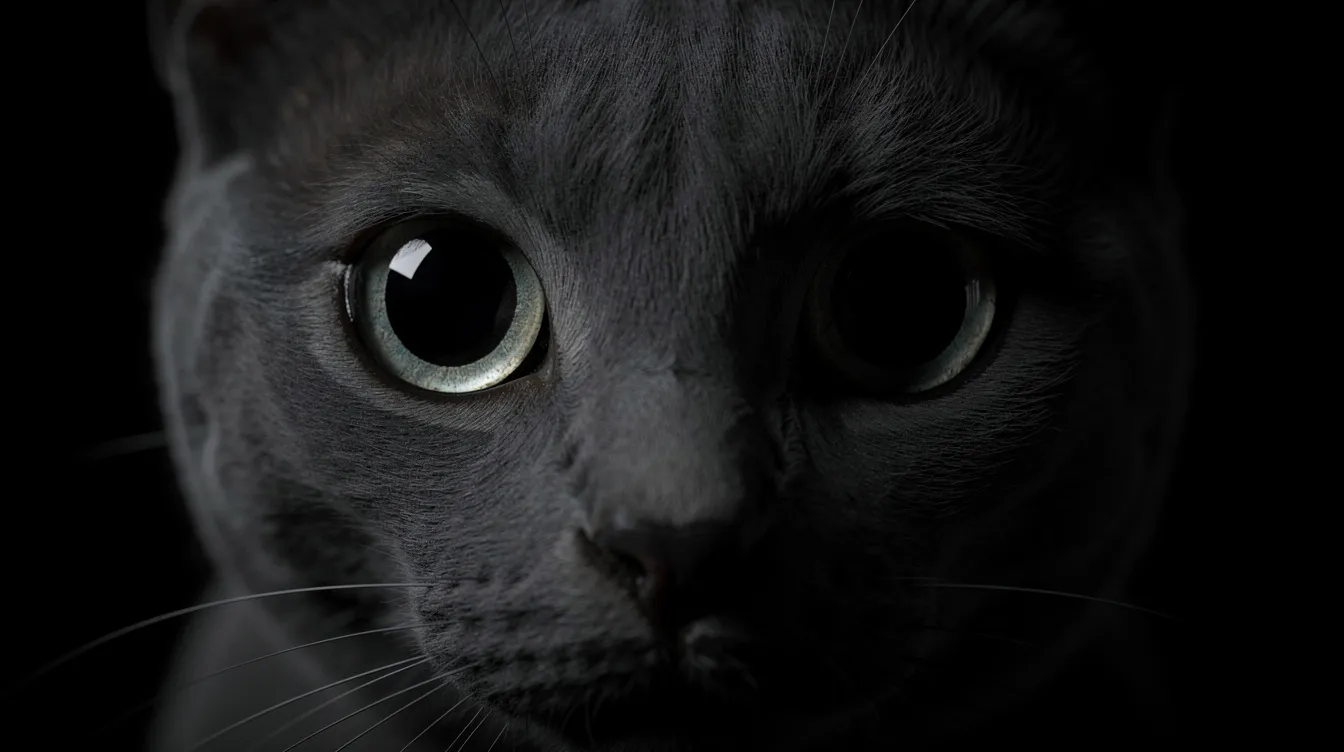
At night, cat's pupils dilate to near-full circles, letting in maximum light. In fact, a cat’s pupils can expand up to three times wider than human pupils, allowing significantly more light to enter their eyes in low-light environments.
-
In bright light, cat's pupils contract to fine lines protecting the sensitive retina.
-
Feline pupils can change diameter 135-300 times versus humans’ 10-15 fold change.
This rapid adjustment of cat's pupils lets cats transition from sunny windowsills to shadowy hallways without temporary blindness—unlike humans who need time to adapt to dim conditions.
How Do Cats See Humans and Their World?
Cats see the world differently from humans. They have a broader field of view at about 200 degrees compared to our 180 degrees, giving them superior peripheral vision for motion detection.
However, visual acuity is lower in feline vision. Humans can discern fine details up to five times farther away than cats. That sharp picture frame across the room? It appears slightly fuzzy to your cat.
Cats compensate by relying heavily on acute hearing, smell, and whisker input. They focus more on movement, outlines, and how light enters their environment rather than tiny facial features. Your cat recognizes you by how you walk and move, not by examining your face in detail.
What Do Cats Actually See in the Dark?
In dimly lit environments, cats see a world that’s less colorful but full of visible shapes, edges, and motion.
With only two cone types (sensitive to blue violet and green-yellow), cats have limited range in color perception:
-
Reds and oranges appear muted, grayish, or brownish
-
Blues, greens, and yellowish tones are more noticeable
-
Overall, fewer vibrant hues compared to human vision
At night time antics, motion and contrast matter most. A moving toy stands out sharply against static backgrounds, while color-based cues are less useful. Some research suggests cats may detect near-ultraviolet light, though this remains under study without consensus.
How Cats Navigate in the Dark Beyond Vision
Even with excellent night vision, cats depend on whiskers, hearing, and memory to move confidently through dim spaces. In very dark corners with almost no light levels, these extra senses become critical.
This multi-sensory approach explains why cats rarely collide with furniture—even when lights are out.
Whiskers: Built-In Proximity Sensors
Whiskers are highly sensitive tactile hairs that pick up slight air movements around obstacles. When a cat approaches furniture in low light environments, whiskers help gauge distance and width—imagine your cat slipping between chair legs in a dark kitchen using whiskers and memory together.
Whiskers on the cheeks, above the eyes, and even on the front legs contribute to this close-range sensing, especially important at night.
Acute Hearing and Mental Maps
Cat ears rotate independently to pinpoint sounds in three dimensions, helping locate dripping taps, scurrying insects, or footsteps in darkness. Cats can hear frequencies up to 65 kHz versus humans’ 20 kHz.
Beyond hearing, cats build detailed mental maps of their home, remembering doorways, furniture layouts, and pathways. When lights go out, this spatial memory combines with subtle sound cues like echoes and floor creaks to guide navigation. This is not a rare event—it’s how cats operate daily.
How to Make Nighttime Safer and More Comfortable for Your Cat
Most healthy adult cats don’t need lights left on. However, small adjustments can support cat’s health, especially regarding vision and eye conditions, in specific situations:
-
Use soft night-lights near staircases, litter boxes, and food/water stations for kittens and seniors
-
Keep furniture layouts stable so your cat’s mental map stays accurate
-
Monitor cats with known eye conditions for nighttime hesitancy or changes in how your pet sees, and seek professional diagnosis and treatment if needed
-
Provide more light in multi-level homes with complex layouts
These simple changes support your cat’s overall health and well being without requiring specialized equipment.
When to Suspect a Vision Problem
Watch for these warning signs affecting your cat’s eyesight and possible vision problems:
-
Bumping into doorframes or furniture
-
Hesitating at the top of stairs
-
Misjudging jumps or avoiding dark rooms previously used confidently
-
Visible changes: persistent cloudiness, unequal pupils, excessive tearing, or redness
Monitoring your cat’s eyesight is important, as any sudden change in your cat's eyesight or nighttime navigation—especially in older cats—warrants prompt veterinary attention. Vision loss can develop gradually, and early intervention matters for depth perception and overall function.
Frequently Asked Questions
Do I need to leave a light on for my cat at night?
Healthy adult cats usually navigate fine without extra lights, using minimal ambient light from outside or other rooms. A small night-light helps in multi-level homes or for kittens, senior cats, or those diagnosed with eye disease. If your cat seems anxious or reluctant to move when lights go out, try a night-light for a week to see if it helps.
Can kittens see in the dark as well as adult cats?
Kittens are born with closed eyes that open around 7-14 days of age, with vision maturing over several weeks. Very young kittens may be clumsier in low light and benefit from gentle lighting near essentials. By a few months old, their low-light vision typically matches adult cats.
Why do my cat’s eyes look huge at night and like thin slits during the day?
This is a normal pupil response controlled by the circular pupil muscles. At night, pupils dilate to let in maximum light; in bright light, they shrink to slit pupils blocking excess illumination. If one pupil is consistently larger than the other or doesn’t change with light levels, consult a veterinarian.
Can cats see the TV or phone screen in the dark?
Cats can see bright, moving images on screens, especially in darker rooms where contrast is strong. They don’t perceive the same color richness or fine details we do but are often intrigued by rapid motion and sound. Interactive cat videos can provide enrichment, though watch for overstimulation in easily excited pet parents’ companions.
Is it true that cats can see ultraviolet light?
Some studies suggest cats may detect near-ultraviolet wavelengths based on lens transparency and retinal structure, unlike humans whose lenses block UV. This research is still developing without full consensus. Regardless of UV perception, a cat’s practical advantages at night come mainly from rod cells, the tapetum lucidum, and pupil control.